Settings
 Help
 Logout


"Would your model still be competitive in 2030?" — what the AI in Practice room in Nicosia actually concluded
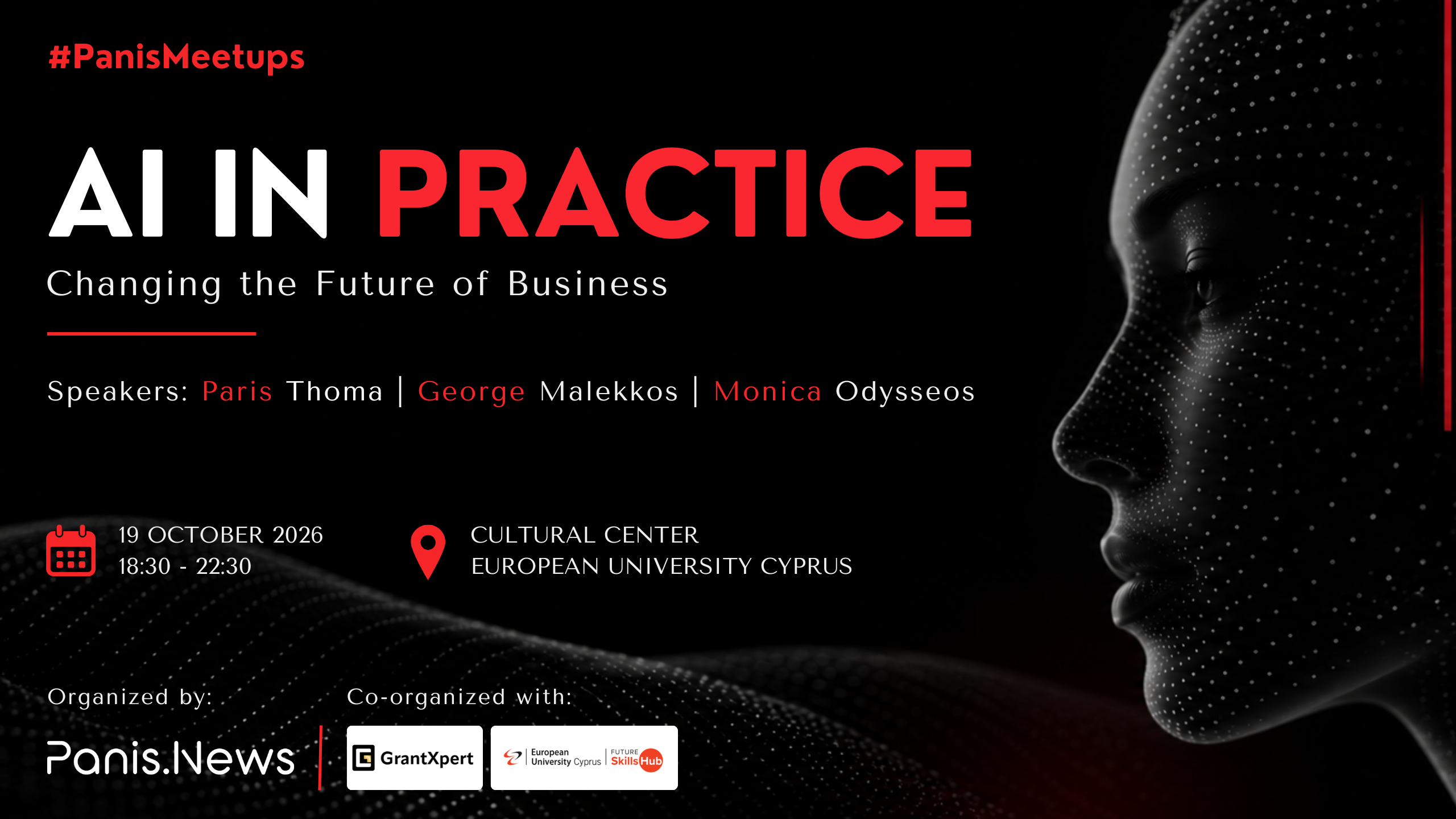
The event preview promised a question — "will your business be here in 2030?" — and the room answered it with an uncomfortable finding: the experimenting is done, and the value is missing. AI in Practice: Changing the Future of Business took place on Monday 19 October 2026 at the Cultural Centre of European University Cyprus in Nicosia, organised by Panis.News in collaboration with GrantXpert Consulting and the Future Skills Hub.
Who was in the room. Demetris Skourides, Chief Scientist of Cyprus, contributed by recorded interview. Marios Pieri, Commissioner of Communications, attended — four days after his office's first formal meeting with the Cyprus Information Technology Enterprises Association (CITEA). Also present were the High Commissioner of India to Cyprus and Professor Loizos Symeou, Rector of European University Cyprus.
The central claim, from the people selling the services. Dr Celia Hadjichristodoulou argued that moving beyond experimentation takes "leadership, curiosity and continuous learning alongside technology" — in other words that the blocker is not model access. Monica Odysseos, Head of the AI and Data Lab at Grant Thornton Cyprus, put it as adaptability: "the ability to learn, unlearn and relearn". Coming from a Big Four-adjacent advisory lead, that is also an admission that most client AI programmes stall at the pilot.
The one concrete demonstration. George Malekkos, CEO of Powersoft Computer Solutions, walked through working AI in retail inventory management and customer service — unglamorous, deployed, and measurable, which made it the most useful ten minutes on the agenda for an SME owner.
The sharpest framing of the day. AI strategy adviser Paris Thomas asked businesses whether their current models would still be competitive in 2030, and pushed the audience to test assumptions with customers rather than bank the efficiency saving and call it a transformation. That is the distinction between an AI line item and an AI strategy, and it is the one most Cypriot firms have not yet drawn.
Why we are carrying the aftermath and not just the preview. Because the gap this conference identified is precisely the gap hackathons are good at closing. A weekend build forces a team to pick one customer problem, ship something testable and present it to people who will say no — which is the loop the room spent a day saying Cypriot companies cannot run internally. The BoC Fintech Hackathon 7.0 on 27–29 November has thirteen challenge tracks with AI for Good at the top of them and a remote Open Day on 3 November; it is open to non-technical participants, mentors and sponsors on the same footing. If you left the EUC auditorium convinced your organisation needs to learn how to do this, that is the cheapest place on the island to practise.
The organiser's own stated aim — Panis Pieri of Panis.News designed the day to deliver "practical knowledge and opportunities to make new connections" — is worth recording, because the follow-through test is whether anything in Nicosia's SME base looks different by the time the National AI Strategy 2032 reaches its first review.
Εκδήλωση: AI in Practice: Changing the Future of Business
Sponsor: Panis.News, with GrantXpert Consulting and the Future Skills Hub at European University Cyprus
23 Oct 2026