Settings
 Help
 Logout


Nicosia has a winner: Axioniq takes the Swarm Coordination challenge at Cyprus' first EUDIS Defence Hackathon
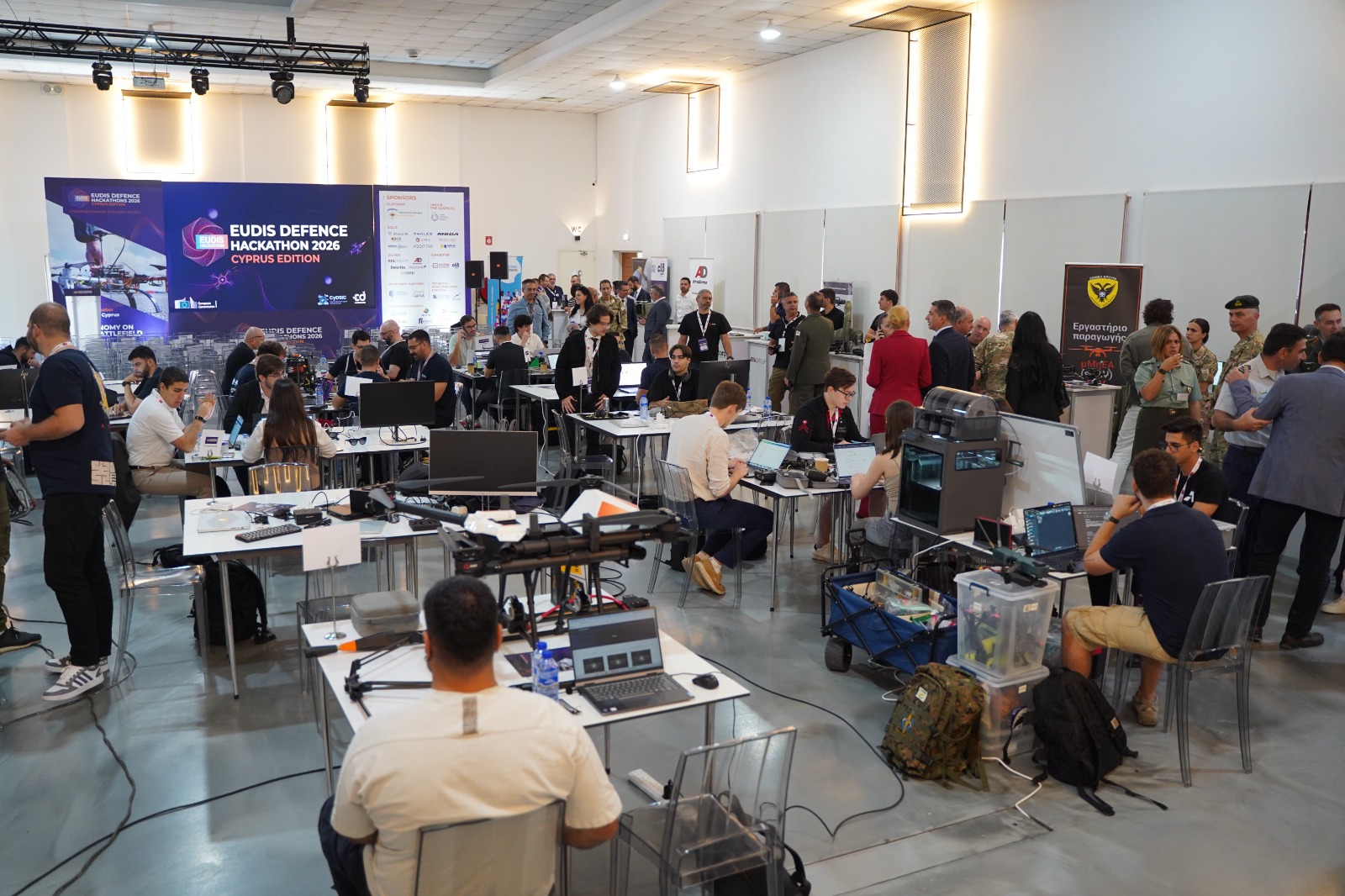
Cyprus hosted a defence hackathon for the first time, and the result is now on the record. Axioniq won the Swarm Coordination challenge at the Cyprus node of the EUDIS Defence Hackathon Autumn 2026, held in Nicosia on 15–17 October as one of eight simultaneous European editions. The organisers have published the full winners list across all eight locations.
What Axioniq built. An autonomous command-and-control platform for unmanned systems — specifically, a multi-drone swarm for autonomous threat detection, tracking and interception. The architecture pairs a reconnaissance drone for initial detection with a coordinated swarm that localises and tracks a target from multiple viewpoints and then dispatches an interceptor, with the human operator kept in control throughout. The organisers' own summary of why it won is the interesting part: the entry demonstrated that "commercially available hardware can be combined with computer vision, autonomous coordination and real-time command software to create a scalable counter-UAS capability." No bespoke airframe, no exotic sensor — off-the-shelf parts and the software that makes them cooperate.
The dual-use argument is baked in. Beyond defence, the team points the same stack at search and rescue, infrastructure inspection and emergency response — the three civilian missions that share the hard problem of coordinating several autonomous vehicles with one operator. Axioniq's published product line reflects that: Commander, a mission-control and fleet-intelligence layer for planning, monitoring and AI-driven optimisation; Core, an onboard edge-compute module that fuses GPS with SLAM so positioning survives in GNSS-degraded or GNSS-denied conditions using LiDAR and other onboard sensors; and Base, which deploys Commander locally at the edge for disconnected field operations.
The room it won in. 23 teams from across Europe, competing on three challenges under the theme "Autonomy on the Battlefield" — navigation without GNSS, swarm coordination and autonomous operations, and counter-UAS protection of critical infrastructure. The Cyprus node offered more than €10,000 in prizes plus access to the EUDIS mentorship programme and ecosystem support running through 2028, and — unusually for a 48-hour build — gave teams the chance to field-test on National Guard training grounds. The edition was organised by C.D. Multimedia with the Cyprus Defence and Space Industry Cluster (CyDSIC) as institutional partner, under the auspices of the Ministry of Defence and the Cyprus Chamber of Commerce and Industry (KEVE), and co-financed by the European Union through the European Defence Fund.
Where Cyprus sits in the European field. The eight winning teams, by location and challenge:
- Cyprus — Axioniq — Swarm Coordination
- Austria — Irnas Technologies — GNSS-Denied Navigation (multi-sensor fusion to compensate for drift and limit error accumulation over time)
- Ireland — UCD UAV — Swarm Coordination (a low-cost mesh of microphone-carrying drones to detect activity in GNSS-denied environments)
- Italy — Elika Technologies — Counter-Drone Autonomous Defence (an electric interceptor exceeding 650 km/h built from sensor fusion and commercial components)
- Latvia — Detexity — Autonomous Border Shield (OrbiScan, a neuromorphic-camera detection system, with the RapidSentinel automatic turret prototype running edge AI)
- Norway — Vale — Situational Awareness in the Arctic (cost-effective coastal surveillance fusing radar, cameras and AI)
- Portugal — UB ROBOTICS — GNSS-Denied Navigation (an offline-ready autonomy stack letting one operator coordinate mixed robot fleets over peer-to-peer radio)
- Sweden — Ententee — Swarm Coordination (a self-organising swarm using cameras, infrared and microphones)
Read the list as a signal. Three of the eight locations handed their top prize to a swarm entry, and almost every winner is a variation on one theme: cheap commercial hardware, plus perception, plus coordination software, assembled into something that used to require a defence prime. That is a software problem, which is why a 48-hour build can produce a credible answer to it — and why Cyprus, with no airframe industry to speak of, was able to field a competitive node on its first attempt.
The honest caveat. The published results identify winners by hosting location, not by nationality — teams travelled to compete, and at least one location's winner is registered elsewhere in Europe. Axioniq won in Nicosia; treat that as the claim, pending the organisers' own detail on the team's base.
What follows. Winning teams gain access to the EUDIS mentorship track and a route toward the programme's European-level stage — the Autumn 2025 edition ran its EU-wide pitching competition in the January that followed, so the next milestone for this cohort is likely to land in early 2027. For anyone in Cyprus who missed this one, the island's next competitive build is Competen.CY and the BoC Fintech Hackathon 7.0 (27–29 November, IDEA Innovation Centre, €16,000 in prizes) at the end of November.
20 Oct 2026